Which Hardware for Which AI Task?
From the €3 chip to the industrial PC
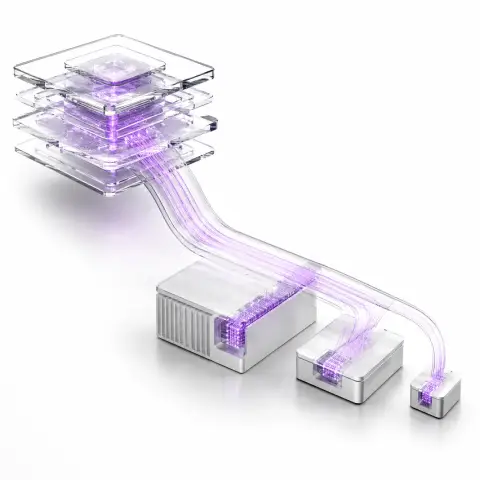
| Hardware | What realistically runs | Typical application | Unit price |
|---|---|---|---|
| ESP32 / ESP32-S3 | Small models (TinyML): anomaly detection, classification of sensor signals, keyword spotting, very simple image classification | Vibration and noise monitoring, machine state detection, gesture recognition | €3 – 10 |
| STM32 (Cortex-M4/M7/M33) | TinyML with STM32Cube.AI or TensorFlow Lite Micro; deterministic, industrial-grade, low power consumption | Predictive maintenance at the sensor, quality checking of signals, battery operation | €3 – 20 |
| Raspberry Pi 4/5 | Smaller image models (MobileNet, YOLO-Nano), audio, simple language models only to a limited extent | Object detection with camera, counting, prototypes | €50 – 120 |
| NVIDIA Jetson (Orin Nano to AGX) | Real-time image recognition with several cameras, segmentation, small LLMs | Quality control on the line, autonomous navigation, robotics | €250 – 2,500 |
| Industrial PC with GPU | Everything up to local 70B language models | Multi-camera systems, local AI assistants, process monitoring | €2,000 – 15,000 |
What TinyML Can Really Do
Three tasks that pay off on the microcontroller
Anomaly detection in sensor data. A model learns what "normal" sounds, vibrates or behaves like — and reports deviations long before a threshold is breached. Training needs a few hours of normal operation; the model itself often needs less than 50 KB of memory.Classification of signals. Which operating state is present, which material is being processed, which gesture was made? With acceleration, current or microphone data such questions can be answered directly at the sensor with over 95 % accuracy.
Pre-processing for the cloud. Instead of streaming raw data permanently, the microcontroller decides for itself what is interesting — and sends only that. This saves bandwidth, energy and storage, and it also works in dead zones.
How an Edge AI Project Works With Us
From the first measurement data to production firmware
| Step | What happens | Duration |
|---|---|---|
| 1. Capture data | Define sensor, sampling rate and recording; we often build a small logging firmware for this first. No good model without good data. | 1–3 weeks |
| 2. Feasibility on the PC | Train the model in Python, check accuracy, estimate model size. This is where the decision is made: microcontroller, Jetson or a classic algorithm after all? | 2–4 weeks |
| 3. Porting | Quantisation to 8 bit, implementation with TensorFlow Lite Micro, STM32Cube.AI or Edge Impulse, integration into your firmware (C/C++), measurement of runtime and memory. | 2–6 weeks |
| 4. Field test | Operation on real devices, retraining with field data, safeguarding against false alarms. | 4–8 weeks |
| 5. Production & maintenance | Update mechanism for models, documentation, SBOM and CRA compliance for products you sell. | ongoing |
Why Hardware Proximity Makes the Difference
A model is useless if it does not run on your chip
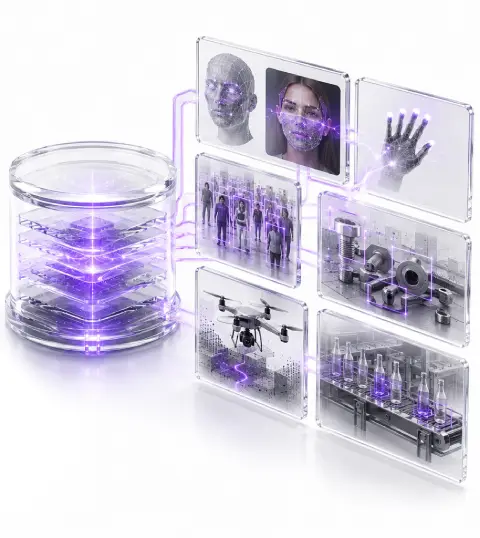
Many AI providers train a model and hand over a Python file. The hard part starts afterwards: The model has to fit into 64 KB of RAM, respond within 5 milliseconds, cope with the interrupt timing of your firmware and work reliably in the field at 60 °C.This is exactly where our strength lies: We have been developing firmware for sensors, controllers and devices for years — configuration software and drivers for ScioSense sensors, remote control for HDG heating systems, autonomous drone navigation for the SPRIND challenge. Machine learning does not arrive as a foreign body with us, but as another function in a firmware we understand.
Frequently Asked Questions About Machine Learning on Microcontrollers
What clients ask us about TinyML, STM32, ESP32 and Jetson
How do I get a machine learning model onto an STM32 or ESP32?
+
The model is trained on a PC, quantised to 8-bit integers and translated with a framework such as TensorFlow Lite Micro, STM32Cube.AI or Edge Impulse into C code that is integrated into your firmware. The decisive factors are model size (usually under 100 KB), runtime per inference and memory requirements — we measure these on your hardware before production release.
Does a language model run on a microcontroller?
+
No. Language models need gigabytes of memory and a GPU. Microcontrollers run models for signal classification, anomaly detection, keyword spotting and very small image tasks. For speech or complex image recognition on the device, an NVIDIA Jetson or an industrial PC is the right tier.
How much data do I need for TinyML?
+
For anomaly detection a few hours of recording of normal operation is often enough. For classification you need a few hundred examples per class. We first build a logging firmware with which you collect the data during regular operation — and tell you honestly if the data is not sufficient.
How much does an edge AI project cost?
+
The feasibility check on the PC starts under €3,000. Porting to the microcontroller and integration into your firmware typically ranges from €8,000 to €30,000, depending on hardware, data situation and requirements for field tests and documentation. For series products, an update mechanism and CRA documentation come on top.
Can we keep our existing firmware?
+
Usually yes. The model is integrated as a module into your firmware — we work in C/C++ and with the common toolchains (STM32CubeIDE, ESP-IDF, PlatformIO, Zephyr). The prerequisite is free memory and computing time; we check that in the first step.
When is a classic algorithm the better choice?
+
When the rule can be formulated: A threshold, an FFT with a cut-off frequency or a state machine is faster, smaller, traceable and needs no training data. Machine learning pays off when the patterns are too complex for rules or differ slightly from device to device. We build both and recommend the simpler option when it is enough.
How can the model be updated later?
+
Via the same route as a firmware update — OTA by radio or via an interface. We store the model as an exchangeable block so that a retrained model can be deployed without recompiling the entire firmware. For products under the Cyber Resilience Act we document the update process accordingly.
The Free AI Check for Your Device
In 30 minutes you know which hardware you need
Tell us about the sensor, the task and the target hardware — we tell you whether it runs on your microcontroller, whether a Jetson is needed or whether a classic algorithm is enough. More about our AI development and our hardware-level programming.
ScioSense
The leading expert in sensor solutions
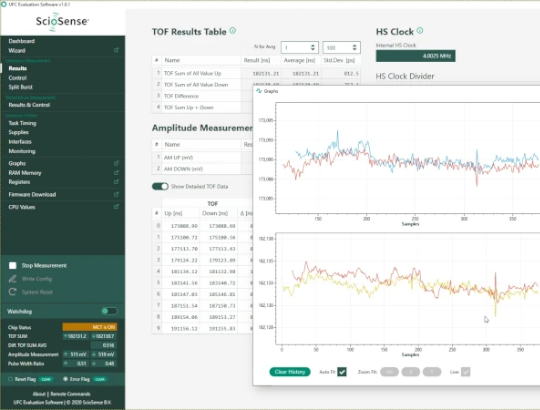
ScioSense provides a range of off-the-shelf environmental sensor solutions, including solutions for monitoring air quality, relative humidity and temperature changes and more. We created the complex Software via embedded programming from the ground up. 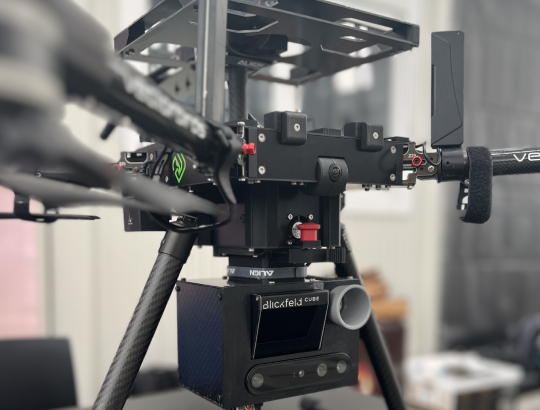
SPRIND Funke
Autonomous drone navigation without GPS
For the challenge run by the German Federal Agency for Disruptive Innovation (SPRIND), we developed the software for fully autonomous wayfinding together with drone manufacturer Vectorbirds Airborne Systems - obstacle detection, OctoMap mapping, and 3D A* path planning, entirely without GPS or manual control.

 Call us
 WhatsApp
 E-Mail

