Typical Price Ranges by Exhibit Type
Reference values for the German market (software, net, excluding hardware and stand construction) — orientation, not a price list
| Exhibit type | Typical cost | What is included |
|---|---|---|
| Touch terminal / info kiosk | €3,000 – 8,000 | Touch application with your content, menu structure, kiosk mode, safeguards for continuous operation |
| Product configurator at the stand | €6,000 – 20,000 | Configuration logic, 2D or 3D visualisation, quote/e-mail dispatch, optional connection to your systems |
| Booth game / gamification | €8,000 – 20,000 | Game mechanics, high score, motion or touch control, social sharing |
| Photo experience (green screen, face mapping) | €8,000 – 18,000 | Live composition, face positioning, print or e-mail delivery, GDPR-compliant deletion |
| Social wall / live feed | €5,000 – 12,000 | Instagram/TikTok/LinkedIn integration, moderation, layout for LED walls |
| Exhibit with face or gesture recognition | €12,000 – 30,000 | Computer vision (OpenCV, depth camera), on-site calibration, robust recognition under trade-show lighting |
| AR/VR application for the stand | €10,000 – 35,000 | Unity/Unreal development, 3D assets, device setup, supervision concept |
| Museum exhibit in continuous operation | €10,000 – 50,000 | Multilingual, accessible, remote maintenance, hardened for years of operation |
What Drives the Price
Five factors determine the effort
- Type of interaction: Touch is the most affordable. Gestures, body tracking, face recognition or voice control require sensors, calibration and extensive testing under trade-show conditions.
- Content and logic: A configurator with 200 variants and pricing rules costs more than an image gallery — not because of the interface, but because of the rules behind it.
- Integrations: Should the exhibit write leads to your CRM, send photos by e-mail or pull data from your ERP? Every interface means development and coordination effort.
- Operating period: Three trade-show days are different from five years in a museum. Continuous operation demands self-recovery after power failures, remote maintenance and updates.
- Lead time: A realistic schedule of 8–12 weeks is cheaper than a project that has to be finished in three — not because of a surcharge, but because requirements stay vague under time pressure and trigger revision rounds.
What Comes on Top of the Software
So that your budget is complete
| Item | Reference value | Note |
|---|---|---|
| Hardware | €1,500 – 15,000 | 43–65" touch display, mini PC or industrial PC, cameras/sensors, LED wall as required. We advise vendor-neutrally; you buy directly or rent via your stand builder. |
| Stand construction / installation | project-dependent | Housing, installation, power supply — via your stand builder; we coordinate the technical requirements. |
| On-site support | daily rate plus travel expenses | Set-up, commissioning, support during the show. With experienced stand teams often only needed for set-up. |
| Content / design | €0 – 5,000 | If your agency supplies graphics, texts and 3D models, this item is dropped. Otherwise we take it on or work with your agency. |
| Re-use | 10 – 25 % of the original price | Adaptation to a new show, new products or an additional language — far cheaper than a new exhibit. |

Three Examples from Practice
Where the effort goes in real projects
Motion-controlled jump&run (Warsteiner HYROX): Game development in Unity, body tracking via depth camera, high-score system. The biggest effort went into a control scheme that works reliably under changing light and with crowds in the background — not into the game graphics.Rock-paper-scissors against Manuel Neuer (adidas, UEFA EURO): Gesture recognition, live video composition, video delivery via QR code, playout on an LED façade. Several technologies in one exhibit — here the price comes from the combination, not from a single feature.
Social wall (ŠKODA, Geneva Motor Show): Hashtag integration, moderation, real-time layout for a very large LED wall. Manageable development effort; the work went into reliability and moderation for over 600,000 visitors.
How to Save Costs Without Sacrificing the Experience
From 20 years of exhibit development
- Ask early. With 10–12 weeks of lead time we can use standard components and test calmly. Rush projects carry no surcharge with us — but they usually lead to more revision rounds because not everything was cleanly defined at the start.
- One experience instead of five features. Visitors remember one strong interaction, not a menu with ten items.
- Supply content. Product data, images, 3D models and texts from your company save agency costs.
- Plan for re-use. An exhibit that runs at three shows costs a fraction per deployment.
- Rent hardware. For one-off deployments, rental equipment via the stand builder is usually cheaper than buying.
Frequently Asked Questions About the Cost of Interactive Exhibits
What clients ask us before the first quote
What is the minimum cost of a simple interactive exhibit?
+
At at², interactive exhibits start at €3,000 net for the software — for example a touch application with your content in kiosk mode. Hardware such as a touch display and a mini PC adds roughly €1,500 to €3,000.
Why does an exhibit with face recognition cost significantly more?
+
Because computer vision has to work reliably under trade-show conditions — changing light, people in the background, reflections. That means camera and sensor selection, on-site calibration and extensive testing. In return you get experiences visitors genuinely remember. Typical market range: €12,000 to €30,000.
Is there a fixed price or do you bill by effort?
+
After a free initial consultation and — for larger projects — a short concept phase, you receive a quote from us with a guaranteed fixed price. Change requests during the project are discussed openly and quantified in advance.
What does it cost to adapt an existing exhibit for another show?
+
Typically 10 to 25 percent of the original software price — depending on whether only content is swapped or new functions are added. We build exhibits from the start so that content can be exchanged without a programmer.
Do you also handle hardware and stand construction?
+
We advise vendor-neutrally on displays, computers, cameras and sensors and coordinate the technical requirements with your stand builder. You usually buy or rent the hardware directly — so you pay no mark-up. Set-up and commissioning on site we take on if you wish.
How long does it take to develop an interactive exhibit?
+
Simple touch applications are ready in 3 to 5 weeks; exhibits with sensors, game mechanics or integrations need 8 to 12 weeks. A buffer for testing under real conditions before the show is important.
How does a museum exhibit compare in cost to a trade-show exhibit?
+
For comparable interaction, museum exhibits usually come in 30 to 50 percent higher because they have to run for years without supervision: multilingual content, accessibility, remote maintenance, automatic restart and a spare-parts concept are mandatory. In return the price is spread over many years of operation.
Your Number Instead of a Range
Free assessment in 30 minutes
Tell us about the occasion, location and idea — in a free initial consultation we tell you which technology makes sense, what your exhibit will realistically cost and how much lead time to plan. More about our interactive exhibits.Are You an Agency or an Exhibition Builder?
We build the software, you stay your client's point of contact
A large share of our exhibits is built on behalf of event and creative agencies, exhibition builders and general contractors — under NDA and, if you prefer, under your brand. What we take on, what deliberately stays with you and how we behave towards your client is set out on a page of its own.

Warsteiner
Full action on the digital obstacle course
For Warsteiner we were allowed to build an interactive exhibit that can be operated by motion control, in line with the fitness theme of the 0.0% drink. With steps to the side, jumping and ducking the visitors can go on an exciting, digital highscore hunt. 
adidas
UEFA EURO 2020 rock paper scissors
For the 2021 UEFA European Championship, visitors to the adidas outlet in Herzogenaurach could challenge Germany goalkeeper Manuel Neuer to an interactive rock paper scissors game. Many emotional games were fought and immediately afterwards sent to friends and family as video evidence. 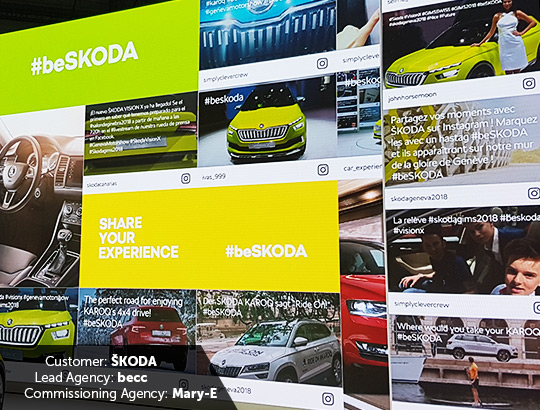
ŠKODA
Interactive Social Wall
The huge ŠKODA Social Wall thrilled everyone at the Geneva Motor Show through direct interaction. Trade fair visitors were able to share their own pictures on different social media channels via the #beSKODA hashtag and became a direct part of the interactive exhibition stand.

 Call us
 WhatsApp
 E-Mail

