An agency looking for a technology partner has two questions. First: will this partner walk off with my client? Second: can they deliver what I promise in the pitch?
The answer to the first question is short. We do not approach your clients past the sales channel — neither during the project nor afterwards. The second question is what the rest of this page answers: with what we take on, what we deliberately leave out, and the technologies we have been building into exhibits since 1999, in more than 85 installations.
The answer to the first question is short. We do not approach your clients past the sales channel — neither during the project nor afterwards. The second question is what the rest of this page answers: with what we take on, what we deliberately leave out, and the technologies we have been building into exhibits since 1999, in more than 85 installations.
What We Take On — and What We Don't
A clear split saves more project time than anything else
What we do
- Technical concept: which interaction, which sensors, what holds up in trade show operation
- Software development — from a touch application to a real-time 3D scene
- Hardware consulting, vendor-neutral: displays, computers, cameras, sensors
- Integration into your setup and technical coordination with your exhibition builder
- On-site installation, commissioning and support
- Maintenance, content updates and reuse at follow-up shows
What stays with you
- Hardware trading. You or your exhibition builder buy or rent directly. That way you pay no markup on equipment we would only be passing through.
- Stand construction and housings. Dimensions, mounting and structural work come from your exhibition builder. We supply the technical requirements for them — power, installation depth, viewing angles, cable routing.
- Graphic and communication concept. The idea, the design and the tone of voice are your work. We implement them instead of overwriting them.

How We Work Together
Four phases, from pitch to follow-up show
- Pitch support. You describe the idea, we tell you whether it holds up technically and give you an effort estimate you can calculate with. Under NDA if you prefer. This phase is free and commits you to nothing.
- Implementation. Once commissioned, you work with one fixed contact and a fixed price. Interim versions come early and are ready to show — to your client as well. We fine-tune the look live with you: in a screen-sharing session you turn the sliders yourself until colour, pace and effect are right, and exactly that setting goes to the show. If you like, your client gets a video of how the exhibit behaves before set-up, rendered from the real software rather than animated.
- Show operation and support. On-site installation and commissioning, availability throughout the run. Under your name if you prefer.
- Reuse. After the show: swap content, add languages, adapt the exhibit for the next appearance. That costs considerably less than a new development — and gives you a reason to follow up with your client.
Confidentiality and Appearance
How we behave towards you and towards your client
- An NDA is the normal case. We sign your agreement before you send us pitch documents. If you do not have your own template, we provide one.
- No approaching your clients. Clients who come through you stay your clients. We do not ask for follow-up work past the sales channel — not after the project ends either.
- White label if you want it. We work under your flag: your project name, your communication towards the client, your name on site at the show.
- References only once released. No project appears on our website, in a proposal or in a talk before you and your client have agreed. That is why most of our exhibits appear nowhere in public.
- You talk to developers. Technical questions are answered by the people who write the software — with no intermediate layer passing your questions along.
Technology Toolbox
What we build exhibits with
| Technology | What we use it for |
|---|---|
| Touch and multitouch | Info terminals, multitouch tables, kiosk applications for continuous operation |
| Face recognition and body tracking | Touch-free interaction, personalised content, motion-controlled games |
| AR and VR | Product experiences on tablet, terminal or standalone headset |
| Digital signage and cross media | Video walls, social walls, proximity sensors, output across several surfaces |
| Product and 3D configurators | Variant logic, real-time rendering, handover to CRM or ERP |
| Sensors and camera technology | Depth cameras, floor lasers, infrared, object recognition — selected for the light and space on site |
| Generative real-time graphics | Effect surfaces that react to visitors and reveal a logo or message, in the client's corporate design |
| Real-time 3D | Unity and Unreal Engine for scenes, simulations and walkable models |
What You Can Measure Us By
What counts in a pitch
- at² has been developing software since 1999. More than 85 of our exhibits are in use worldwide, many of them running continuously for years.
- Development is 100 % in Germany, at our Nuremberg and Kempten locations. No time zone between you and the developer.
- For our DIRIMOTE technology — smartphones as a remote control for interactive shop windows — we received the DIHK's WE DO DIGITAL Award in 2017.
- Among the clients we are allowed to name are ŠKODA, adidas, Warsteiner, Volkswagen and MINI. Most of our projects run without our name on them — which is exactly what this page is about.
Budget Range for Your Calculation
Software, net, excluding hardware and stand construction
The software for an interactive exhibit typically falls between €3,000 and €20,000; complex installations with sensors, face recognition and live video reach around €50,000. Hardware and stand construction come on top and run through you, not through us. Adapting an existing exhibit for a follow-up show typically costs 10 to 25 percent of the original software price.The full breakdown by exhibit type — touch terminal, configurator, booth game, photo experience, social wall, AR/VR, museum exhibit — is in our pricing guide How much does an interactive exhibit cost? Those figures exclude hardware and stand construction and can go straight into your calculation.
Frequently Asked Questions from Agencies and Exhibition Builders
What partners ask us before the first project
Do you work under NDA?
+
Yes, that is the normal case for agency projects. We sign your non-disclosure agreement before you send us pitch documents, client names or concepts. If you do not have your own template, we provide one.
Will you appear in front of our client?
+
Only in the way you want us to. We can stay in the background, join technical meetings as your development partner, or look after the exhibit on site under your name. What we do not do: approach your clients past the sales channel — neither during the project nor after it ends.
Do you supply hardware?
+
We advise on displays, computers, cameras and sensors on a vendor-neutral basis and coordinate the technical requirements with your exhibition builder. The hardware is bought or rented through you. That way you pay no markup on equipment we would only be passing through. On-site installation and commissioning we take on if you want us to.
How quickly do I get an effort estimate for a proposal?
+
A first assessment of feasibility usually takes one phone call. An effort estimate you can calculate with in your proposal normally follows within a few working days. If your submission deadline is tight, say so — we will work to it.
What happens after the show?
+
The exhibit stays usable. We develop from the start so that content can be replaced without a programmer. For a follow-up show, content is swapped, languages are added or functions are extended — typically for 10 to 25 percent of the original software price. We also take on maintenance and remote support beyond the show if you want.
Can you take over existing installations?
+
Usually yes. We look at what exists — source code, hardware, documentation — and tell you honestly whether taking it over makes sense or whether a new development works out cheaper in the end. If the source code is missing, work can often still continue, but with more effort.
Do You Have a Project in the Pitch Phase?
Feasibility and effort estimate, free of charge and under NDA
Tell us what your client wants to achieve and what constraints you are working with. We will tell you whether it holds up technically, which form of interaction makes sense and what effort you should budget for in your proposal. If we are the wrong people for the job, we will say that too.

Warsteiner
Full action on the digital obstacle course
For Warsteiner we were allowed to build an interactive exhibit that can be operated by motion control, in line with the fitness theme of the 0.0% drink. With steps to the side, jumping and ducking the visitors can go on an exciting, digital highscore hunt. 
adidas
UEFA EURO 2020 rock paper scissors
For the 2021 UEFA European Championship, visitors to the adidas outlet in Herzogenaurach could challenge Germany goalkeeper Manuel Neuer to an interactive rock paper scissors game. Many emotional games were fought and immediately afterwards sent to friends and family as video evidence. 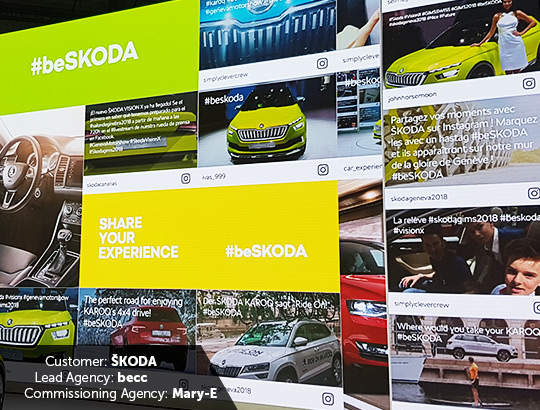
ŠKODA
Interactive Social Wall
The huge ŠKODA Social Wall thrilled everyone at the Geneva Motor Show through direct interaction. Trade fair visitors were able to share their own pictures on different social media channels via the #beSKODA hashtag and became a direct part of the interactive exhibition stand.Satisfied Customers
A selection from our event branch




















View Referencesover 80 % of our revenue comes from repeat customers — see what we've built for them.


 Call us
 WhatsApp
 E-Mail


